Building vs. Buying a Home in Akwa Ibom (2026): Discover the 2026 costs, expert tips on land verification in Uyo, and the “Labor of Love” vs. “Plug-and-Play” reality of the Land of Promise real estate market in Akwaibom state.
- Building vs. Buying a Home in Akwa Ibom (2026): Which is Better?
- 1. Building from Scratch: The "Labor of Love"
- 2. Buying a Finished Home: The "Plug-and-Play"
- 3. The Financial Breakdown- 2026 Comparison
- Expert Tips for the Akwa Ibom Market
- 4. Problem Solving: Which One Should You Choose?
- 5. The 2026 Verdict
Building vs. Buying a Home in Akwa Ibom (2026): Which is Better?
Introduction
Ownership is more than just a roof over your head in Akwa Ibom; it’s a statement of Dakkada/ARISE—the spirit of rising to your greatness. As we navigate the economic landscape of 2026, the question isn’t just “Can I afford a home?” but rather “Should I stress myself to build it, or just pay and move in?”
Akwaibom generally known as “The Land of Promise, where the roads are smooth and the greenery is lush, now has valuable real estate market which has matured significantly. Gone are the days when building was the only “respectable” way to own a home. Today, gated estates are springing up from Osongoma to the outskirts of Airport Road, offering a lifestyle that “self-builders” often struggle to replicate.
However, each path has its own set of potholes. Let’s break down the reality of building versus buying in Akwa Ibom in 2026.
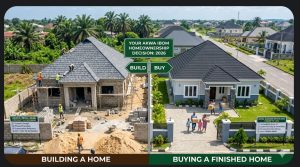
1. Building from Scratch: The “Labor of Love”
Building a home in places like Eket, Ikot Ekpene, or the developing zones of Uyo is a marathon, not a sprint. It’s for the person who wants their kitchen specifically facing the sunrise and a master bedroom large enough to host a small village meeting.
The Pros: Customization and Phased Funding
The biggest draw of building is financial flexibility. In 2026, with the naira still finding its rhythm, not everyone has ₦60 million sitting in a savings account. Building allows you to “pay as you go.” You buy the land this year, do the foundation next year, and perhaps roof it by the third year.
Read Also: Top 15 Highest-Paying Companies in Nigeria: Salary Scales, Work Days, and Expert Career Tips
- Design Control: You aren’t stuck with a developer’s idea of a “modern” living room. You choose the tiles, the POP designs, and the quality of the plumbing.
- Equity Gain: Usually, if you manage the project well, the finished house is worth more than the sum of its parts.
The Cons: The “Inflation Tax” and Supervision
Building in Nigeria is a battle against the “Inflation Tax.” In 2026, the price of cement or reinforcement rods can change between the time you get a quote and the time you send the money to the merchant.
- The Stress Factor: Unless you have a trusted relative or a professional site manager, you will be cheated. From “disappearing” bags of cement to laborers who suddenly have three grandmothers to bury in one month, the headaches are real.
- Time: A self-build project can take 18 to 36 months. During that time, you are likely still paying rent elsewhere.
2. Buying a Finished Home: The “Plug-and-Play”
The 2026 Akwa Ibom real estate market has seen a surge in “Ready-to-Live” homes. From the high-end duplexes in Shelter Afrique to the more affordable bungalows in Royal Villa Estate, the options are expanding.
See more: Akwa Ibom State Government Online Services
The Pros: Speed and Security
- Immediate Gratification: You pay, you get the keys, you move in. This is perfect for the diaspora Akwa Ibomite coming home for the holidays or the professional who just got a promotion.
- Estate Amenities: When you buy in a managed estate, you aren’t just buying a house; you’re buying 24/7 security, paved roads, and a functional drainage system. Try building that yourself on a single plot in a regular neighborhood.
- No “Omonile” Drama: In Akwa Ibom, community issues aren’t as aggressive as in Lagos, but they exist. Developers usually handle all “settlements” with the village youths (Mkparawa) before you even see the house.
The Cons: The Developer’s Margin
- The Cost of Convenience: You are paying for the developer’s profit, their marketing, and their overhead.
- Hidden Defects: That beautiful coat of Dulux paint could be hiding a damp wall or low-quality electrical wiring.
3. The Financial Breakdown- 2026 Comparison
Now, let’s look at a typical 3-Bedroom Detached Bungalow in a mid-brow area like Nwaniba Road, Abak Road or Oron Road extensions.
Option A: Building It Yourself
|
Item |
Estimated Cost (₦) |
|---|---|
|
Land (1 Plot) |
₦6,000,000 |
|
Survey & Documentation |
₦1,200,000 |
|
Foundation to Lintel |
₦12,000,000 |
|
Roofing (Stone-coated) |
₦6,500,000 |
|
Finishing (Tiling, POP, Painting) |
₦11,000,000 |
|
Total |
₦36,700,000 |
Option B: Buying Finished
A similar 3-bedroom bungalow in a serviced estate in 2026 currently averages ₦48,000,000 to ₦55,000,000.
The Mathematical Reality:
To calculate the “Convenience Premium” (P_c), we use:
- P_c = Cost_{Buying} – Cost_{Building}
-
P_c = 50,000,000 – 36,700,000 = 13,300,000
You are essentially paying roughly ₦13.3 million for the privilege of not supervising laborers and having a tarred road to your gate. For some, that’s a bargain. For others, it’s a whole second house in the village.
Expert Tips for the Akwa Ibom Market
To ensure your investment is safe, whether you are building or buying, follow these “Golden Rules” from real estate veterans in the state.
1. The “Flood Check” (Very Important!)
Akwa Ibom is beautiful but rainy. Before buying land or a house, visit the site during or immediately after a heavy rainstorm. Areas around Atiku Abubakar or certain parts of the Nwaniba axis are notorious for “seasonal swimming pools.” If the gutters aren’t flowing, walk away.
2. Verify with the Ministry of Lands
Don’t just trust a “Power of Attorney” or a “Survey Plan.” Take the coordinates to the Ministry of Lands and Housing at the Secretariat. Verify if the land is under government acquisition or if it’s earmarked for a future road project. In 2026, the state is aggressive about urban renewal; don’t let your house be the one the “Yellow Chalk” marks for demolition.
3. The 30% Buffer Rule (For Builders)
If your quantity surveyor tells you the house will cost ₦40 million, assume it will cost ₦52 million.
Total Budget = Project Estimate × times 1.30
This 30% buffer accounts for the fluctuating cost of materials like cement and the inevitable “change of mind” when you see a nicer bathroom set at the Timber Market.
4. Inspect the “Wet Areas” (For Buyers)
When inspecting a finished home, don’t look at the living room. Look at the bathrooms and the kitchen. Check the plumbing for leaks and the tiles for “hollowness” (tap them to see if they sound empty). If a developer cut corners on the plumbing, they likely cut corners on the foundation.
4. Problem Solving: Which One Should You Choose?
Case A: The “I Want It Now” Investor
Okay, let’s make me it more practical, If you are an Akwa Ibomite living in the UK, USA, or even Lagos, and you want a place to stay when you visit for Christmas, BUY. The stress of managing a site from a distance, even with “trusted” family, will likely end in a high-budget comedy of errors.
Case B: The “Legacy” Builder
If you live in Uyo, have a reliable architect, and want a house that will be your “forever home” with specific structural integrity, BUILD. You can ensure that the ratio of cement to sand is actually what the engineer prescribed.
Case C: The Middle Ground (Off-Plan)
In 2026, many developers in Uyo offer “Off-Plan” sales. You pay while they are still at the foundation stage. This is often 15–20% cheaper than a finished home and allows you some input on the finishing. It’s the best of both worlds, provided the developer has a track record of actually finishing projects.
5. The 2026 Verdict
Akwa Ibom is no longer a “civil servant state” where things move slowly. With the expansion of the Ibom Solutions Hub and the industrialization drive, property values are climbing at about 12% annually in prime Uyo locations.
- Build if you have the time, the patience, and the desire for a 1-of-1 home.
- Buy if you value your mental health and want to start enjoying your investment immediately.
Final Advice: No matter what you choose, ensure your title is a Certificate of Occupancy (C of O). In the real estate game, a house without a solid title is just a very expensive pile of blocks.
Expert Insight: “In 2026, land is the only thing they aren’t making more of. Whether you build or buy, the secret is to get into the market now. Today’s ‘expensive’ is tomorrow’s ‘I wish I had bought it then.'”
Which path are you leaning towards for your Akwa Ibom dream home? drop in the comment section let’s know how best to advise you.
Even if you a Nigerian in diaspora or you base outside the state, you could get something a very good apartment or building in a conducive Akwaibom environment.

Iniobong is the Founders of EazySaves and a seasoned Career Consultant with over 4 years of experience in Virtual HR Management. Holding an M.A. and B.A. in Linguistics, Iniobong combines his deep understanding of structured communication with SEO expertise to provide Nigerians with clear, actionable advice on career growth and financial literacy. He is dedicated to helping young professionals navigate the digital economy with ease.
The co-founder is Anietie Asuquo